
How to Check Criminal History in Nassau County
Begin with the record that answers the real question. A future court date belongs in WebCriminal. A final, certified result comes from the court that heard the case. The New York State Office of Court Administration, or OCA, sells a statewide exact-name and date-of-birth search. A person reviewing their own fingerprint-linked history must instead use the New York State Division of Criminal Justice Services, or DCJS. Recent custody starts with the Nassau County Sheriff's Department, while an arrest narrative stays with the police agency that wrote it.
Names alone can point to the wrong file. Gather the full name, date of birth, known spelling or alias, incident date, town, report number, and court docket when available. Nassau County has overlapping police and court jurisdictions. The street where an event occurred can be more useful than the community name printed on mail.
- Define whether you need a police report, booking status, court case, public statewide court history, or your own DCJS record.
- Search WebCriminal for a pending Nassau County case or future appearance, using the county filter when helpful.
- Contact the originating court for older files, a Certificate of Disposition, or a result that the online system does not show.
- Send a focused FOIL request to the arresting police agency or sheriff when the needed record is an arrest, incident, or custody file.
- Use OCA CHRS for its public statewide court product, or IdentoGO and DCJS for fingerprint-based self-review.
Nassau County Criminal Records Across Five Offices
Nassau County criminal records do not sit in one master public file. The record trail runs through the police agency, Nassau County Correctional Center, the criminal court, OCA, and DCJS. Each office holds a different view. An NCPD report can describe what officers saw. A sheriff booking record tracks intake and release. A court file shows the charge that was filed, later motions, plea or verdict, and sentence. OCA compiles qualifying electronic court data, while DCJS joins fingerprint-linked arrest and disposition cycles for the person who is the subject of the record.
The Nassau County government directory is a practical first stop for current county departments and contacts.

The directory helps locate the custodian, but it does not merge court, police, jail, and state criminal history into one result.
| Needed record | Start with | Main limit |
|---|---|---|
| Incident or arrest report | Arresting police agency | Release may require redaction or proof of involvement |
| Booking or custody | Nassau sheriff | No confirmed public live roster |
| Charge and outcome | Originating court clerk | Online data may omit old, disposed, or sealed matters |
| Public statewide court search | OCA CHRS | Exact name and date of birth; not certified |
| Own fingerprint-linked history | DCJS Personal Record Review | Subject or the subject's attorney only |
Official New York Background Checks
New York separates the public court-history product from the official repository record. OCA Criminal History Record Search accepts an exact full name and date of birth. It costs $95 for each name and birth-date combination searched. The result can report qualifying pending cases and convictions transmitted by courts across the state. It excludes sealed matters and other non-disclosed categories, and it is not a certified court record.
DCJS Personal Record Review is different. A person or that person's attorney may request a suppressed or unsuppressed fingerprint-matched rap sheet. The public cannot order another person's DCJS file. The suppressed response omits sealed material. The unsuppressed response can help the subject identify sealed cycles or missing dispositions. For a federal self-review, the FBI offers its own fingerprint-based Identity History Summary, which is separate from both Nassau County and New York records.
Choosing a Nassau County State Record Check
The $95 OCA search and the $17.50 DCJS review answer different questions. OCA uses an exact name and date of birth against qualifying electronic court data. Every alias or birth-date variation is a separate OCA search. DCJS uses fingerprints and limits access to the subject or authorized attorney. That makes it the sound route when someone needs to review their own full New York rap sheet, trace a missing case outcome, or confirm whether sealing reached the repository.
For DCJS, book through IdentoGO by IDEMIA with service code 15464Z for a suppressed review or 15465F for an unsuppressed review.
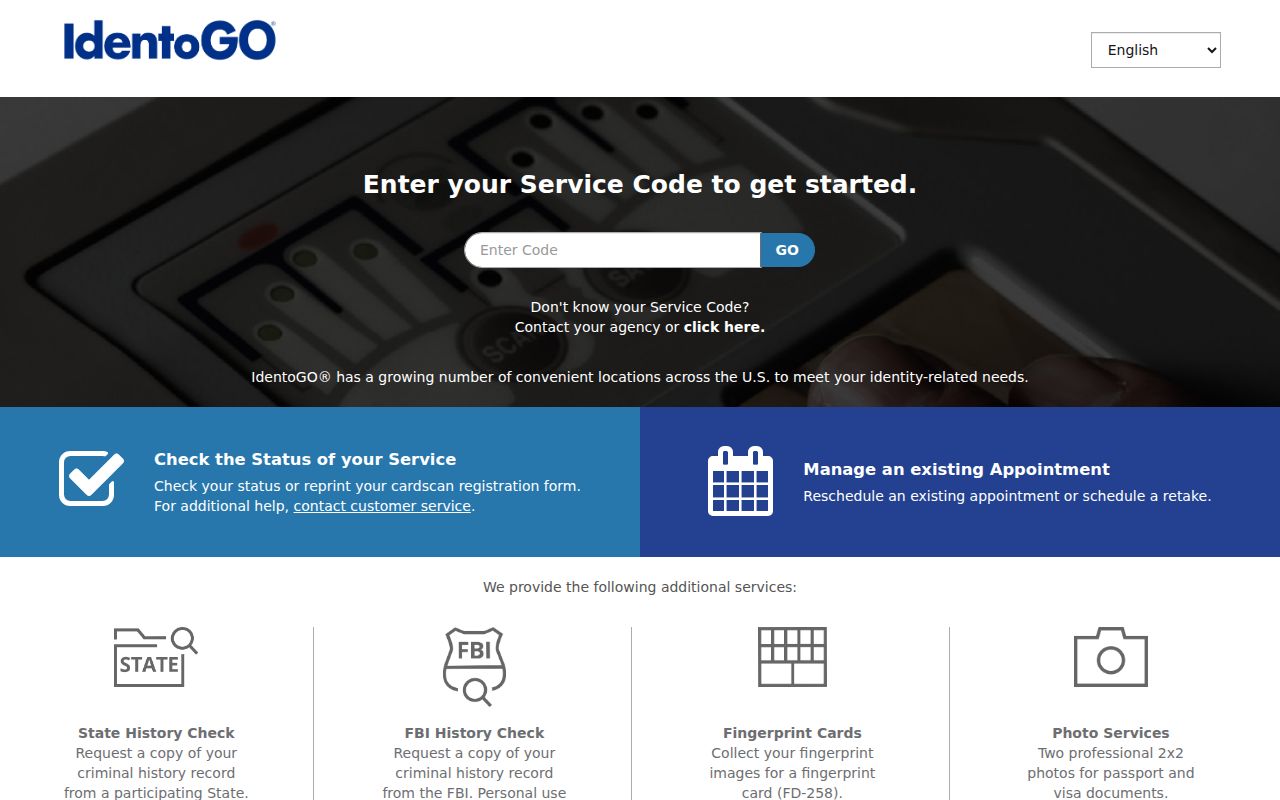
The live enrollment system chooses the appointment site. Enter a Nassau ZIP and select an available location instead of relying on an old storefront address.
The DCJS record-review instructions explain accepted identification, payment, and the correction path.
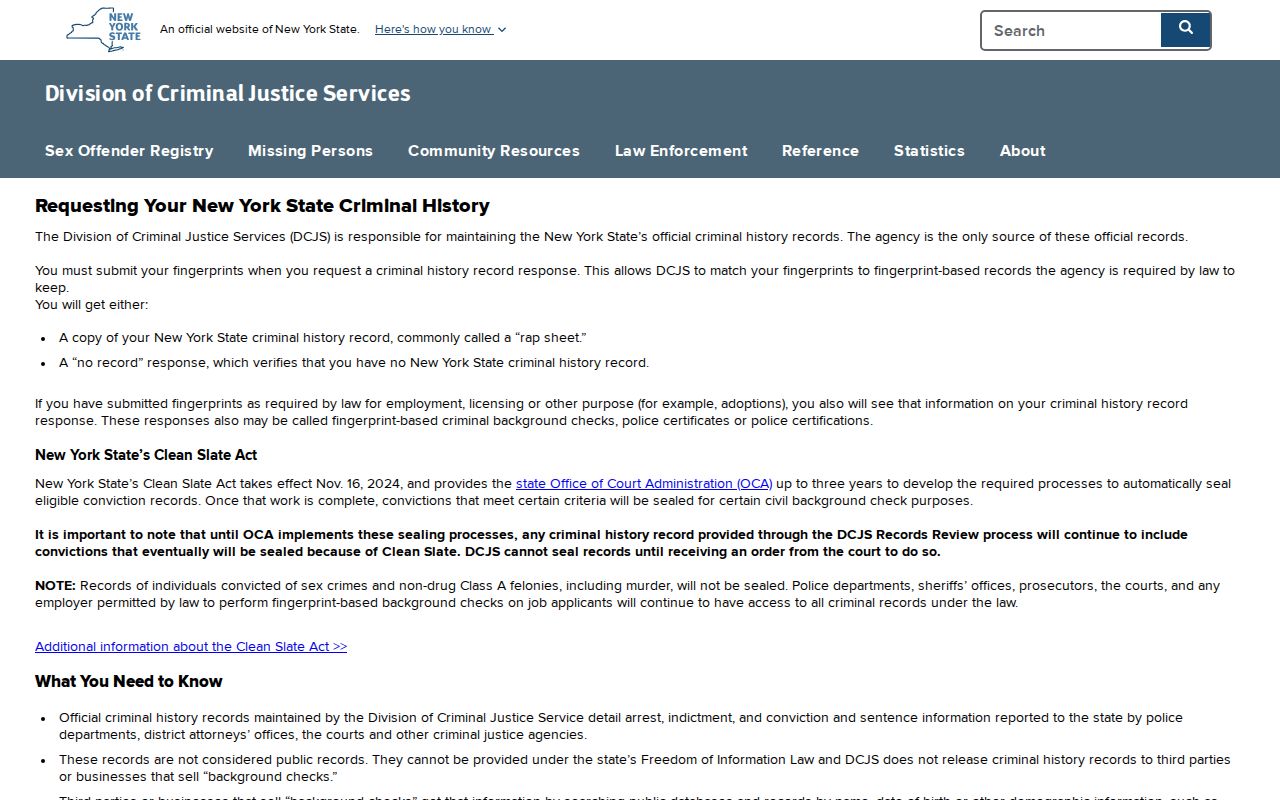
DCJS estimates three to four weeks after receipt and sends the result by U.S. mail, with no pickup option.
| Official channel | Current fee | Best fit |
|---|---|---|
| OCA CHRS | $95 per name and DOB | Public statewide qualifying court-history summary |
| DCJS Personal Record Review | $17.50 | Fingerprint-based review of one's own New York record |
| UCS-LRS2 local court search | $5 per two-year period | Exact-name search in one selected court |
| FBI direct electronic request | $18 | One's own federal Identity History Summary |
Types of Criminal Records
The event creates several Nassau County criminal records, often at different times. A police incident report may exist even when no arrest follows. An arrest report states the officer's basis for custody and the charges alleged then. The sheriff creates a separate booking file at intake. The court file begins with the accusatory instrument and changes as the case moves. Fingerprints and later dispositions may flow to DCJS as one arrest cycle.
- Incident report: the responding agency's account of the event, witnesses, location, and evidence.
- Arrest and booking records: custody facts, alleged charges, identity processing, bail or remand, and release or transfer.
- Criminal court file: filed charges, calendars, motions, plea or verdict, sentence, and final disposition.
- Warrant record: a judge's order tied to a court or enforcement file, not a countywide public name list.
- Supervision or registry entry: probation, parole, incarceration, or Sex Offender Registry information held by the proper county or state agency.
- Arraignment
- The first court appearance at which charges are addressed and release or custody conditions may be set.
- Disposition
- The outcome of a charge, such as dismissal, acquittal, plea, or conviction after trial.
- Rap sheet
- The DCJS fingerprint-linked record that combines reported arrest, prosecution, court, sentence, and supervision events.
- Certificate of Disposition
- An official court document stating the result of a criminal case.
Nassau County Arrest Records Through NCPD FOIL
The Nassau County Police Department uses an electronic Freedom of Information Law form for police-created reports. The form asks whether the requester is an attorney, the requester's role in the event, and whether the record is a Case Report, Arrest Report, MV-104 accident report, 911 record, or another item. It also requests the incident date, address, town, names, and date of birth when known. Involved requesters may need two identity documents, including a driver's license or passport. A representative may need notarized authorization.
The NCPD electronic FOIL form gives each submission a reference number.
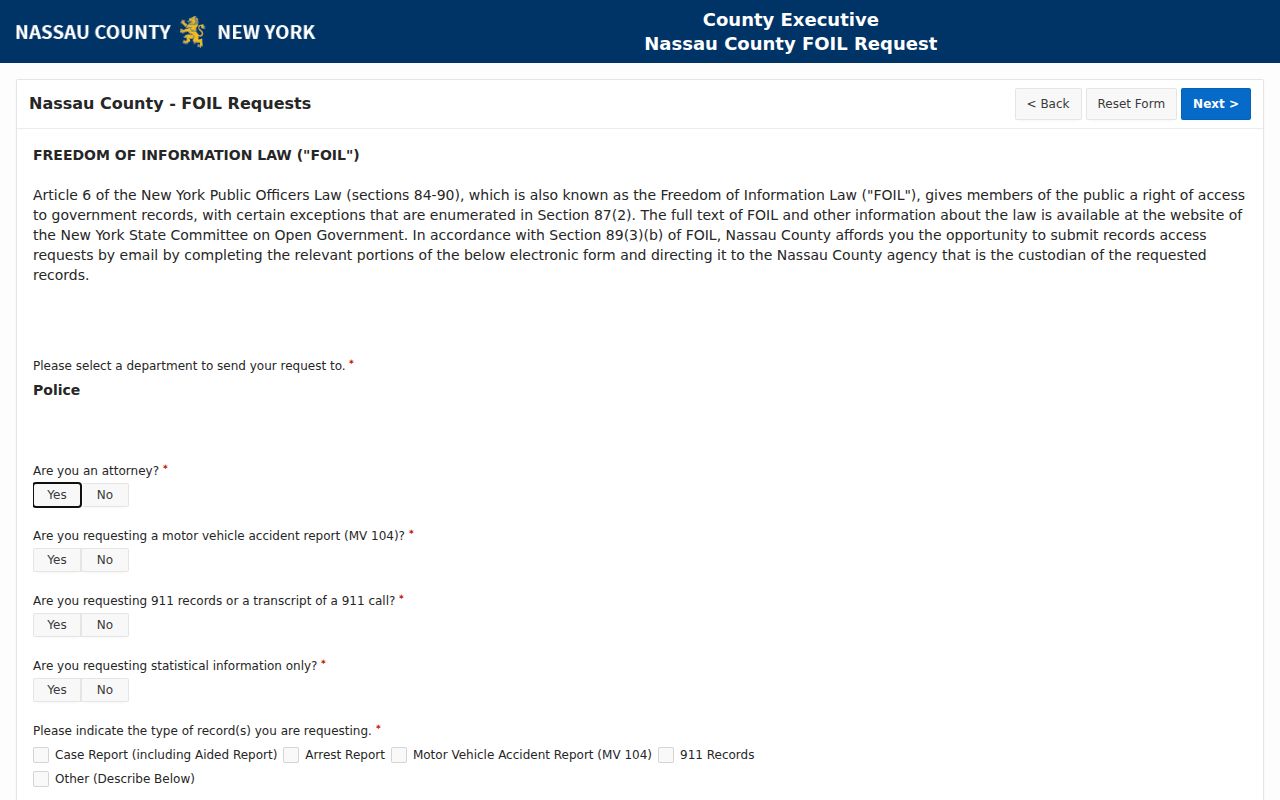
Keep that number. The portal says it is the only way staff can locate the request later. A report from Glen Cove, Long Beach, a village department, State Police, or MTA Police must go to that creating agency, not NCPD.
Ordinary FOIL copies up to 9 by 14 inches may cost no more than 25 cents per page unless another law sets the fee. Within five business days, the agency must grant the request, deny it in writing, or acknowledge it with an approximate response date. The law permits redaction or withholding for privacy, active enforcement work, confidential sources, and other stated exemptions.
What a Nassau County Criminal Record Shows
A Nassau County criminal record must be read in context. The arrest charge describes an allegation at custody. The prosecutor may file another charge, and the conviction can differ again. A rap sheet groups these stages under a fingerprint-linked cycle, while a court file provides the docket-level detail. Missing disposition language can mean a reporting delay rather than an open case. Obtain the court's Certificate of Disposition before asking DCJS to correct a cycle.
| Name and identifiers | Current and alias names, birth data, NYSID or FBI number when assigned, and fingerprint-linked identity fields. |
|---|---|
| Arrest and booking data | Arrest date, agency, arrest or transaction number, intake event, and alleged charges. |
| Charges and statutes | Penal Law or other code section, degree, class, count, and status at each reported stage. |
| Disposition | Dismissal, acquittal, plea, conviction, declined action, or sealed notation when the selected record may show it. |
| Sentence | Jail, prison, probation, fine, or other reported terms tied to the conviction. |
| Custody or supervision | County custody, DOCCS events, warrants, probation, parole, or post-release supervision when reported. |
When Nassau County Criminal Cases Do Not Appear
A blank WebCriminal result does not prove there is no Nassau County criminal case. The system focuses on pending matters and future appearances transmitted by participating courts. A disposed case, old local file, sealed matter, name mismatch, or matter with no future date may be absent. Town and village disposition data also has known historic gaps, especially before comprehensive reporting began in 2007.
Try four fallbacks. Ask the likely court clerk to search the exact name and date of birth. Use OCA CHRS when its statewide public scope fits. Request the police report from the agency that made the arrest. For review of your own complete New York record, use an unsuppressed DCJS request. If two records conflict, the certified court disposition is the key source for a correction.
Note: Sealing can lawfully suppress a result, so an online no-result should never be described as proof that an event did not occur.
Public Access Laws
New York law separates agency records, court records, and repository criminal histories. FOIL applies to executive agencies, but it does not force an office to create a new answer or disclose every part of an investigative file. Court records follow Unified Court System rules. DCJS states that official criminal histories are not public and cannot be obtained through FOIL for another person.
Key statutes:
Public Officers Law Article 6 sets FOIL access, exemptions, response timing, and appeal rules.
CPL 160.57 establishes Clean Slate automatic sealing for qualifying convictions after the statutory waiting period.
CPL 160.59 permits an application to seal a limited number of eligible convictions after ten years.
Correction Law Article 6-C governs registration and public notification through the New York State Sex Offender Registry.
A focused request gives the agency a record type, date range, incident or case number, location, and known names. This reduces delay and makes any denial easier to assess or appeal.
Nassau County Warrant Record Checks
No official comprehensive public Nassau County warrant database was confirmed. WebCriminal may show a case status or warrant indicator, but it is not a safe real-time warrant confirmation system. Bench warrants usually live with the issuing court. Arrest warrants, search warrants, and DOCCS parole warrants are separate instruments, and active details may be withheld when release would interfere with enforcement.
If a possible warrant concerns you, use the case identifier and contact the issuing court clerk or a lawyer about the correct calendar or surrender procedure. Do not rely on a third-party listing, and do not make an unplanned visit to police headquarters based only on web data. The court can confirm whether an old hit was cleared, while a targeted request to the law-enforcement custodian may obtain releasable related records.
Nassau County Federal Criminal Records
Federal criminal cases from Nassau County belong to the U.S. District Court for the Eastern District of New York, not Nassau County Court. The district has courthouses in Brooklyn and Central Islip, and the U.S. Attorney's Office for the Eastern District prosecutes those cases. A county clerk, NCPD records officer, or Nassau sheriff employee cannot provide the federal docket.
PACER is the official federal docket system. It requires an account and ordinarily charges 10 cents per page, capped at $3 per document, with quarterly fees waived when the account incurs $30 or less. Federal custody is checked through the Bureau of Prisons Inmate Locator. That result does not cover Nassau County pretrial detention or New York state prison. A person seeking their own federal fingerprint history uses the FBI Identity History Summary process instead.
Sealed, Expunged & Restricted
New York uses record sealing more often than true expungement. Favorable terminations generally seal under CPL 160.50. Qualifying violation outcomes may seal under CPL 160.55. Youthful-offender adjudications are confidential, and juvenile delinquency matters are Family Court records rather than ordinary public criminal convictions. Sealing restricts access. It does not always destroy the underlying record.
CPL 160.59 allows an application after ten years for up to two eligible convictions, with no more than one felony. The applicant gathers a Certificate of Disposition, sworn information about other applications, and reasons for sealing. The district attorney may oppose, and an opposed request requires a hearing. Violent felonies, most registerable sex offenses, Class A felonies, and other listed categories are excluded.
Clean Slate under CPL 160.57 took effect on November 16, 2024. Qualifying misdemeanor and felony clocks are generally three and eight years, measured from sentence or release as the statute directs. Pending charges, current supervision, sex offenses, and non-drug Class A felonies can block eligibility. OCA has an implementation period, so an eligible record may still appear until the sealing order reaches DCJS.
Nassau County Probation and State Parole Records
Probation is county-run. Parole is not. The Nassau County Probation Department operates its Administration and Criminal Division at 400 County Seat Drive in Mineola. The main number is 516-571-5700. Its current hours are Monday through Thursday from 9 a.m. to 7:15 p.m. and Friday from 9 a.m. to 4:45 p.m., with appointments through the assigned officer.
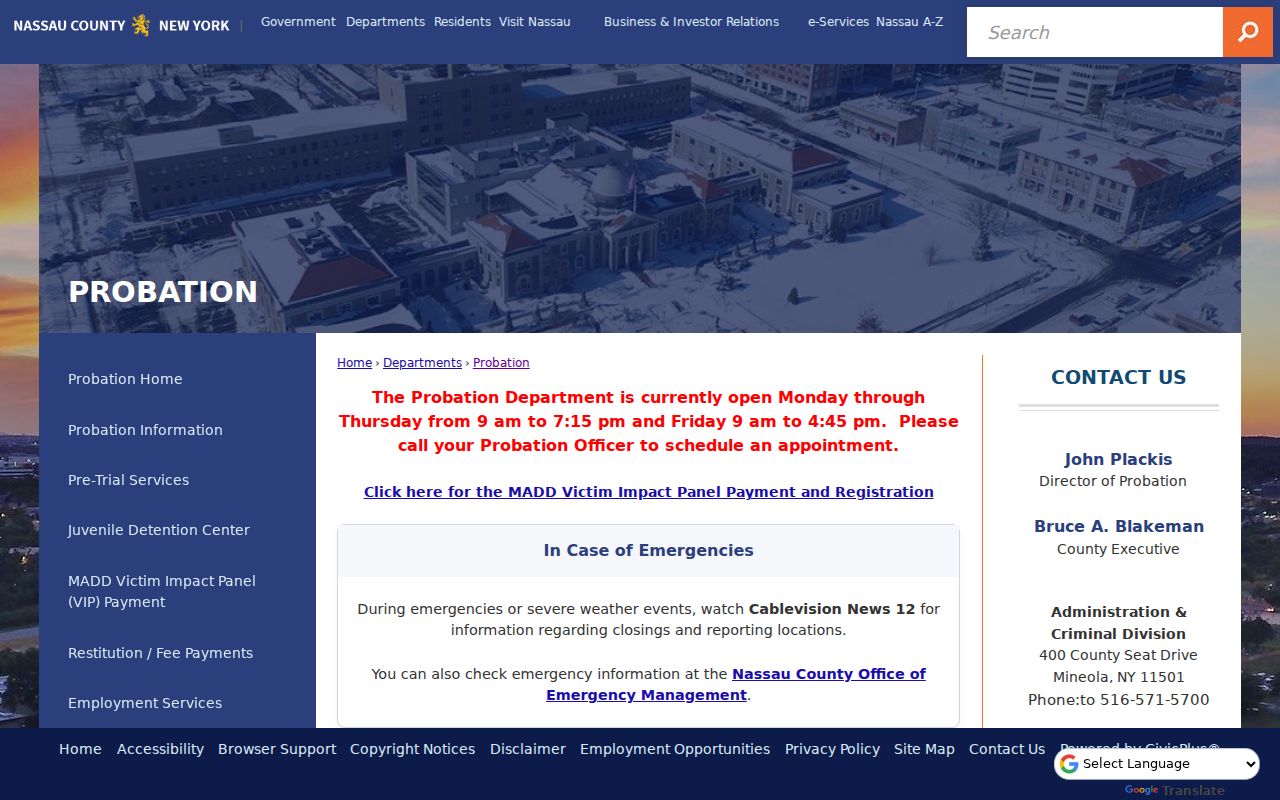
The county page is the source for current office access, but confidential conditions, treatment, tests, officer details, and presentence material are not a public name-search product.
New York State DOCCS manages parole and post-release supervision. A court file can confirm that a sentence included probation, while the DOCCS parolee channel may show qualifying state supervision. A Nassau County probation violation can appear in the court docket. A state parole violation remains under DOCCS and the Board of Parole.
Criminal Records by City in Nassau County
Nassau County has two incorporated cities. Both keep city police reports through city channels, and both have state-operated City Courts. Long Beach ranks first among the two by population. Glen Cove ranks second. A city arrest may still lead to booking at the county Correctional Center and, after a felony indictment, a file in Nassau County Court.
Long Beach Criminal History
35,029 residents in the 2020 Census. Police FOIL starts with the city form, while City Court sits in City Hall.
Glen Cove Criminal History
28,088 residents in the 2024 estimate. The City Clerk receives police FOIL requests, and the city has its own court.
Nassau County Criminal Records in Mineola
The Mineola records campus is a cluster, not one counter. Nassau County Court is at 262 Old Country Road, with a West Wing at 252 Old Country Road. It handles felony indictments and trials. The County Clerk preserves Supreme and County Court records. The district attorney also operates from 262 Old Country Road. Nassau Supreme Court and its Help Center are at 100 Supreme Court Drive. Nassau District Court, which handles misdemeanors and felony preliminary matters, is instead at 99 Main Street in Hempstead.
The Nassau County Sheriff's Department page identifies the separate correctional operation in East Meadow.
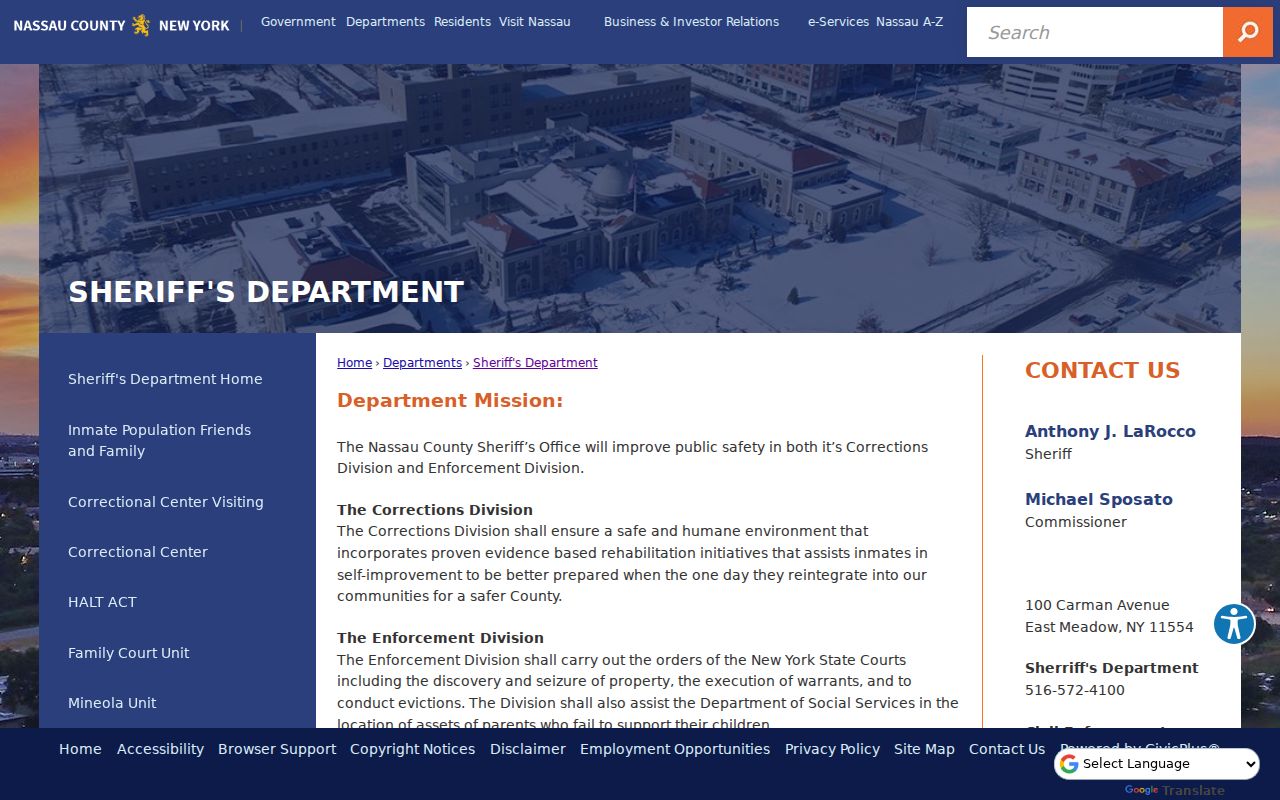
This separation matters. A Mineola clerk cannot provide the NCPD incident report, and the sheriff cannot certify a court disposition. Visitors seeking court help can use the Help Center and Law Library's forms, limited terminals, scanning, Wi-Fi, and language or accessibility contacts. The Mineola LIRR station is a few blocks from the felony courthouse area, while District Court and the jail require separate trips.
Nassau County Court
262 Old Country Road
Mineola, NY 11501
516-493-3710
Nassau County Correctional Center
100 Carman Avenue
East Meadow, NY 11554
Use the sheriff page for current phone routing.