
Running a Sex Offender Check in Nassau County
The New York State Sex Offender Registry is maintained by the Division of Criminal Justice Services, or DCJS. Its public web directory shows Level 2 and Level 3 registrants. It does not publish Level 1 profiles. That split matters in Nassau County because a blank web result cannot rule out a Level 1 registration. Searchers who need to ask about any level must use the registry's phone channel and provide both a name and a qualifying identifier.
Begin with the question the search must answer. A name search helps when the person is known. The Nassau County filter or a ZIP search supports neighborhood awareness. NY-ALERT can track moves into a chosen community of interest, while the national registry layer is useful when a move across state lines is possible. None of these channels should be treated as a fixed list. A profile reflects information reported to DCJS and the last updates shown in the record.
Nassau County Level 1 Registry Access
New York's Level 1 designation means a court found a low risk of repeat offense. The public web directory excludes that level by design. This is not a Nassau County data gap, and it is not proof that no registration exists. The official alternative is a phone search at 800-262-3257. The caller must give the person's name plus one exact identifier: an address, date of birth, driver's-license number, or Social Security number.
The identifier rule guards against loose name-only matches. It also makes the phone channel different from browsing the Level 2 and Level 3 directory. A caller who lacks a second identifier cannot use the line as a broad list search. Registry staff can be reached at 518-417-3384, weekdays from 8 a.m. to 4 p.m., or at SORRequests@dcjs.ny.gov for registry process questions. The registry office mailing address is 80 South Swan Street, 10th Floor, Albany, NY 12210.
Note: The absence of a Level 1 web profile reflects New York's disclosure rules, not a finding that the person is unregistered.
Searching the New York State Sex Offender Registry
The state search provides two practical routes for a Nassau County check. Name mode uses last name with an optional first name. Geography mode can use Nassau County or a five-digit ZIP code. Spelling and location matter, so repeat a search with a known alias or another relevant ZIP when the facts support it. Review the registry disclaimer before using any result.
- Open the official DCJS public directory and read its conditions and accuracy notice.
- Search by last name and optional first name, or choose Nassau County and a ZIP code for a place-based search.
- Compare the result list with known facts. Do not rely on a similar name or photograph alone.
- Open the matching profile, note its update date, risk level, status, address, and supervising jurisdiction, then confirm urgent concerns with local police.
| Field Label | Type | Required | Notes |
|---|---|---|---|
| Last Name | Text | Name mode | Searches public Level 2 and Level 3 entries |
| First Name | Text | No | Narrows a name search; spelling matters |
| County | Dropdown | Geography mode | Select Nassau for county results |
| ZIP Code | Text | Geography mode | Uses a five-digit ZIP area |
| Search / Clear | Buttons | No | Runs the query or resets the form |
The official Level 2 and Level 3 search screen shows the fields used for a Nassau County lookup.
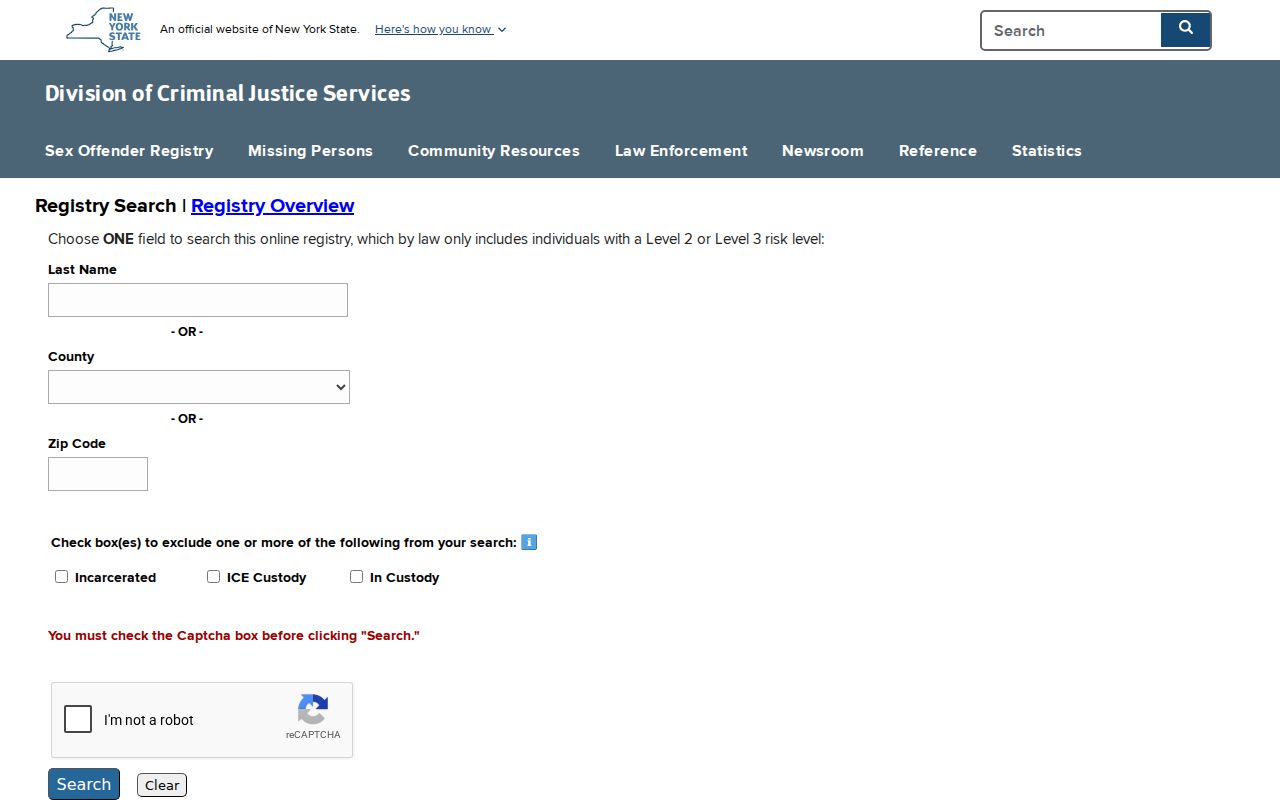
The interface confirms that the public directory is a state tool filtered to Nassau, not a separate list kept by the county.
Nassau County Registry Alerts
A place-based search answers what the registry shows now. An alert serves a different need. The DCJS registry overview routes New Yorkers to NY-ALERT, which can send notice when a Level 2 or Level 3 registrant reports a move into a selected community of interest. That feature is useful for Nassau County residents who want updates without rerunning the same ZIP search each day.
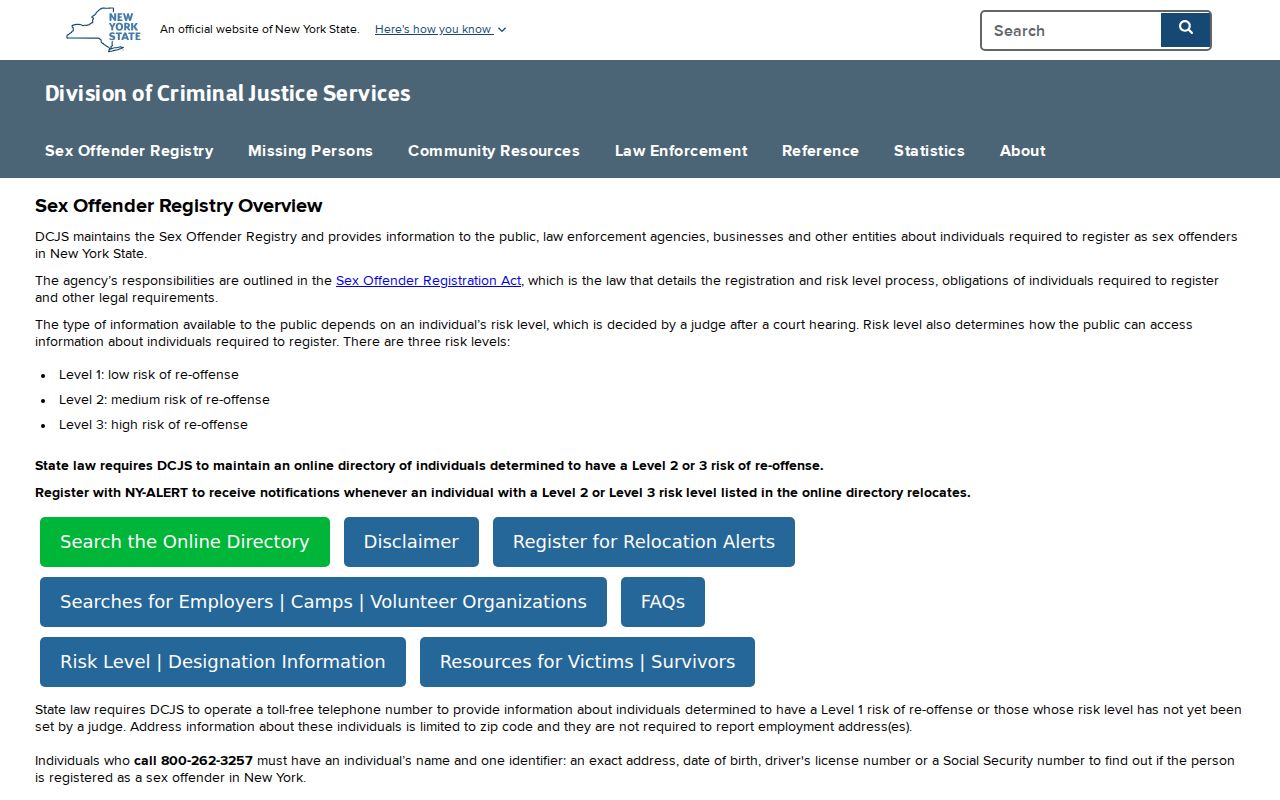
The overview connects the public directory, alert option, phone route, and registry contact details in one official state channel.
Nassau County Registry Cross-State Checks
For a person who may have left New York, use the U.S. Department of Justice National Sex Offender Public Website. NSOPW federates records from participating jurisdictions instead of replacing their databases. A no-result may reflect a jurisdiction's disclosure rules or network status, so check the relevant state registry as well.
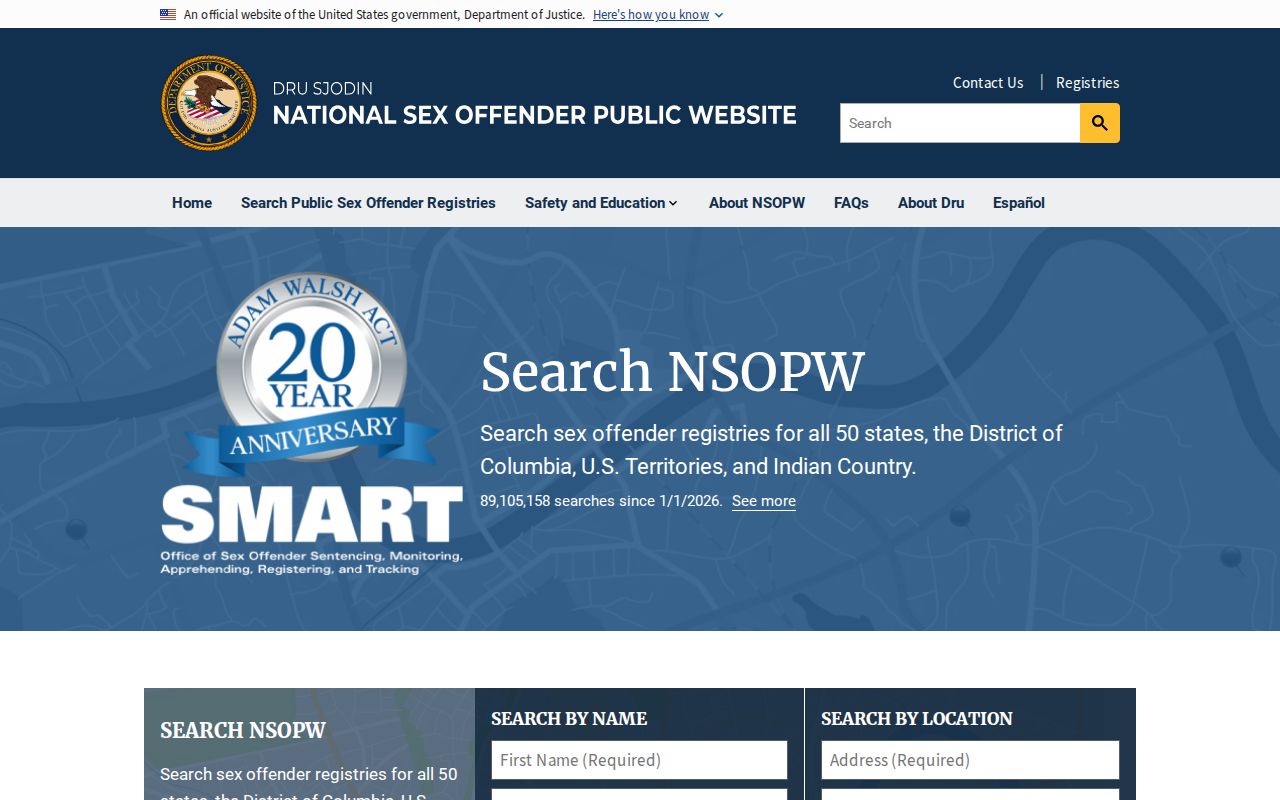
The national interface adds geographic reach, while DCJS remains the primary source for New York risk levels and public profile details.
What a Registry Profile Shows
A public Nassau County registry profile can combine identity, court, supervision, address, and vehicle details. Each field has limits. An address is the location reported through the registration process, not a guarantee that the person is present at a given moment. Photographs may come from more than one date. Offense text describes the registerable conviction and related court facts, while the risk level comes from a separate judicial hearing.
| Name and Aliases | Reported primary name and alternate names used to help distinguish the registrant |
|---|---|
| Photos and Description | Available photographs, age or birth information, height, weight, hair and eye color, and reported marks or tattoos |
| Public Address | Releasable residence and, where authorized, school or institution information for Level 2 or Level 3 entries |
| Registerable Crimes | Current and prior registerable crimes, jurisdiction, statute, conviction, sentence, and authorized victim-age category |
| Risk and Designation | Level 2 or Level 3 plus any separate sexual predator, sexually violent offender, or predicate offender designation |
| Status and Oversight | Compliance, update or verification date, parole or probation conditions when public, and supervising or local police jurisdiction |
| Vehicles | Reported make, model, color, year, and plate information |
Level 1 profiles do not appear in this interface. The phone route remains the lawful public access channel for a qualified inquiry about that level.
Correcting a Nassau County Registry Address
If a Nassau County address appears wrong, do not contact the listed person or household. DCJS directs the public to the law-enforcement agency with jurisdiction over that address. Jurisdiction is unusually important here. NCPD serves much of the county, but Glen Cove and Long Beach have their own police departments, and several villages also maintain police agencies.
Use the exact street address to identify the right department. Report the profile name, listed address, and the reason the data seems wrong. The local agency can assess a compliance concern and send verified information through the registry process. Call 911 for an immediate safety emergency. A routine data concern belongs on the non-emergency channel of NCPD, Glen Cove Police, Long Beach Police, or the appropriate village department.
The broader Nassau County criminal history overview explains why city, village, county, court, and state records can have different custodians.
Registration Requirements and Levels in New York
A judge assigns New York's risk level after a hearing. Level 1 indicates low risk, Level 2 medium risk, and Level 3 high risk. Special terms such as sexual predator, sexually violent offender, and predicate sex offender are separate designations. They can affect the duty to register, but they should not be collapsed into the three risk levels. Baseline duration and public access also differ by level.
| New York Level | Public Method | Baseline Duration |
|---|---|---|
| Level 1, low risk | Qualified phone search; no public web profile | Generally 20 years, unless a qualifying special designation requires life |
| Level 2, medium risk | Public web directory and phone search | Generally life |
| Level 3, high risk | Public web directory, phone search, and broader authorized notification | Generally life |
The DCJS registry questions and answers explain levels, phone access, registration, updates, and lawful use.
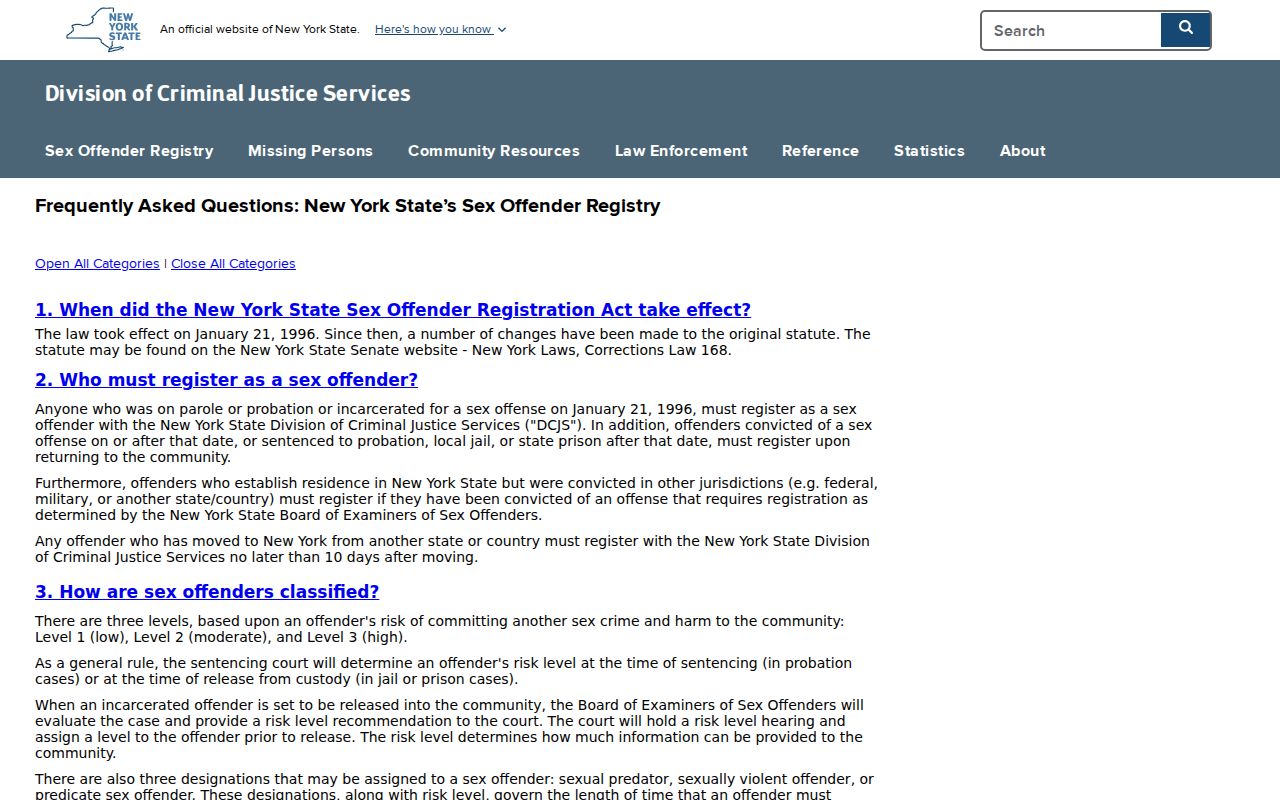
The state material shows why level, public visibility, duration, and special designation must be read as distinct profile facts.
Nassau County Registry Levels Versus Tiers
New York risk levels and federal SORNA tiers answer different legal questions. A Nassau County profile's Level 1, 2, or 3 label states a risk finding assigned under New York law. It should not be renamed Tier I, II, or III. Federal tier rules classify offenses for federal registration standards, and the labels are not interchangeable.
This distinction prevents two common errors. A reader should not infer a New York duration from a federal tier name, and should not use a state risk level to guess what another jurisdiction will display. Read the actual profile, the New York duration rules, and any special designation. For a move outside New York, confirm the new state's record rather than carrying the Nassau County label over as if it were national.
The Ten-Day Nassau County Registry Address Rule
A registrant must report an address change in writing to DCJS no later than ten days after moving. At sentencing or release, the court or correctional agency begins the registration process and sends the required forms to DCJS. The state then provides registration information to the law-enforcement agency that has local jurisdiction. This flow explains why an update can involve more than one office.
For the public, the profile's update date is a key reading aid. Preserve the date of the search when recording a concern because address and compliance information can change. An old screen capture may no longer match the live file. Report a suspected lapse through the correct local police agency so it can be checked against the state record and current supervision facts.
Note: A saved Nassau County registry result records what the interface showed on that date, not a permanent address finding.
Nassau County Offender Residency Rules Need Context
New York does not impose one universal Nassau County distance ban on every registrant. Executive Law §259-c(14) and Penal Law §65.10 can restrict certain people under parole, post-release supervision, or probation from knowingly entering or living within 1,000 feet of school grounds or facilities that primarily care for children. Whether the restriction applies depends on the offense, supervision status, and legal category.
A map pin alone cannot answer that legal question. The registry profile may show public address and supervision information, but it does not replace the sentencing court's order or the supervising agency's conditions. Residents should avoid labeling an address unlawful based only on distance. A suspected breach should go to the responsible police or supervision office for review.
Lawful Use and Community Notification
Correction Law Article 6-C governs New York's registration and public-notification system. Under §168-l, law enforcement may notify vulnerable organizations or the community at the level the law permits. DCJS provides public information for awareness and safety planning. It does not authorize exclusion, punishment, confrontation, or a private investigation of a listed person or household.
Use registry information lawfully. DCJS warns that using registry data to harass or commit a crime against anyone may itself be a crime. Correction Law Article 6-C and §168-l govern access and notification. Report concerns to law enforcement and do not confront a registrant.
Juvenile delinquency and youthful-offender adjudications are not criminal convictions and generally do not require registration. A juvenile offender convicted of a registerable sex crime can have a duty to register. This is another reason not to infer status from age, rumor, an old case reference, or an incomplete search result.
Nassau County Registry Reports Go Local
The county's split law-enforcement map controls where a compliance report goes. The Nassau County department directory routes residents to NCPD for much of Nassau County. Glen Cove Police covers addresses within Glen Cove, and Long Beach Police covers Long Beach. A village police department may be responsible for an address inside its jurisdiction. DCJS maintains the state registry, but the local agency is best placed to check conditions at the address.
Provide facts, not conclusions. Give the public profile name, the exact location, when the concern arose, and what appeared inconsistent with the record. Keep the search date. The police can decide whether the report requires a registry check, a welfare or safety response, or referral to another agency. For a state-process question rather than a local compliance concern, use the DCJS registry staff phone, email, or Albany mailing address.