
Arrest History in Nassau County
Nassau County Police Department makes arrests across much of the county, but it is not the only custodian. Glen Cove and Long Beach have their own police departments. Many villages maintain police agencies, while New York State Police, MTA Police, and campus public-safety agencies may create records within Nassau County. The Sheriff's Department controls sheriff-created records and the separate booking or custody file at the Nassau County Correctional Center.
An arrest history is not one fixed document. The police incident report describes the event and investigation. An arrest report records the officer's basis for custody and the alleged charges. Jail intake creates a booking record. The court then receives an accusatory instrument and records filed charges, appearances, pleas, rulings, and the outcome. Fingerprints from a qualifying arrest are reported to DCJS and later matched with prosecution and disposition data. Those products can differ without any one of them being a complete substitute for another.
Nassau County Arrest Requests at NCPD
When NCPD made the arrest, use its electronic FOIL form and choose Arrest Report or Case Report. The portal asks whether the requester is an attorney, whom an attorney represents, whether the requester was involved, and that person's role. It also collects the incident date, address, town, location, names, and birth dates when known. The long description field can hold added facts that help staff locate the exact report.
An involved requester must supply the identity material requested by the form, which may include two IDs with one driver's license or passport. A representative may need notarized authorization. Keep the FOIL reference number after submission because the portal says it is the only way staff can locate the request later. This is a request channel, not a promise that every field will be released. Active-investigation details, private information, victim or juvenile data, and confidential law-enforcement material may be withheld or redacted.
New York FOIL requires the agency within five business days to grant access, deny in writing, or acknowledge the request and give a reasonable approximate response date. A denial can be appealed. Ordinary paper copies up to 9 by 14 inches are generally capped at 25 cents per page absent another statute, while electronic production can involve actual reproduction cost.
How to Look Up Nassau County Arrests
There is no verified public Nassau County daily booking search. A reliable lookup therefore uses the creator-agency and custody chain. Full name, date of birth, incident location, approximate arrest date, report number, booking identifier, and court docket are the best matching facts. Do not treat the absence of a web result as proof that no arrest occurred or that the person has been released.
- Identify the arresting department from the paperwork or exact incident address. Route NCPD, Glen Cove, Long Beach, village, state, transit, and campus records to their own custodians.
- Request the arrest or case report from that agency. Use NCPD's electronic FOIL form or the correct city, village, or state records channel.
- Contact the Nassau County Correctional Center for present custody, then submit a focused sheriff or county FOIL request for releasable booking data if needed.
- Search WebCriminal for the filed case and next appearance. Ask District Court, a city court, a town or village court, or County Court for the case record and final disposition.
- For one's own statewide fingerprint history, request an unsuppressed DCJS Personal Record Review. Use DOCCS lookup after a transfer to state prison.
The steps answer separate questions. A jail contact can confirm custody but not the final case result. A court docket can show filed charges but not the full police narrative. DCJS personal review is restricted to the subject or the subject's attorney and arrives through the official fingerprint process.
Nassau County Booking at Carman Avenue
The Nassau County Correctional Center at 100 Carman Avenue in East Meadow is the county's principal detention facility. After an arrest that leads to jail intake, staff confirm identity, inventory property, photograph and fingerprint the person when required, enter intake charges and warrants, perform health screening, and classify housing. The booking record remains with the Sheriff's Department even when the linked criminal case belongs to another court.
The official Correctional Center page is the source for the facility view below.
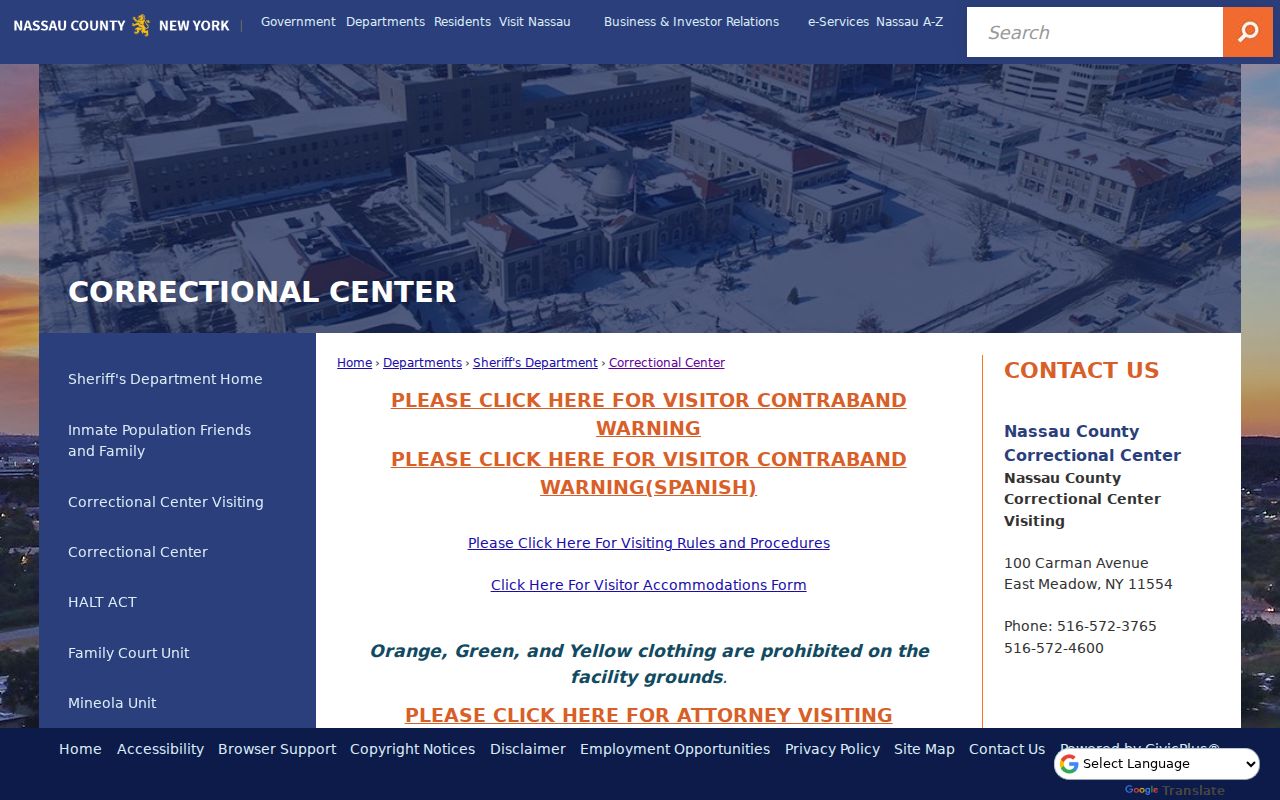
This source should be used for current facility and custody contact instructions, not mistaken for a live booking roster.
Nassau County Sheriff's Department
Correctional Center
100 Carman Avenue
East Meadow, NY 11554
Use the official sheriff page for the current main and inmate-information phone routing.
Ask for a booking date, booking identifier, intake charges, custody dates, status, and release or transfer information rather than requesting a vague “criminal history.” A narrow request helps the custodian identify the record and determine which parts are releasable.
What an Arrest Record Shows
A Nassau County arrest report and a booking response overlap, but they are not identical. Police record the arrest authority and investigation. Jail staff add intake and custody fields. Public copies may redact date of birth, home address, phone, medical data, victim and juvenile information, witnesses, or methods tied to an active investigation. The research did not confirm a public Nassau booking profile, so the field list below describes the documented record categories, not an online display.
| Record Identifier | Incident, complaint, arrest, booking, or fingerprint transaction number |
|---|---|
| Date and Location | Arrest or admission time, incident street, town, and transport destination |
| Arresting Agency | Department, precinct or unit, and officer when releasable |
| Arrest Authority | Warrant identifier or stated warrantless basis |
| Charges | Alleged offense, Penal Law or Vehicle and Traffic Law code, and level at arrest |
| Custody Status | Bail or remand entry, housing facility, release, or transfer data when releasable |
| Photograph | Requested from the custodian and reviewed for privacy, safety, sealing, and investigation limits |
Charges in the police or booking record are allegations. They may change when a prosecutor files the accusatory instrument, a grand jury returns an indictment, or a plea resolves the case. Match the arrest to the court docket, then obtain a Certificate of Disposition when the final outcome must be established.
Nassau Arrest Records Follow the Agency
The community name alone may route a request to the wrong office. A Hempstead arrest could involve NCPD, Village of Hempstead Police, or a court located in Hempstead. Glen Cove and Long Beach police reports stay with those cities. A village department does not transfer its report to NCPD merely because the event happened inside Nassau County.
| Creator | Official request route | Starting detail |
|---|---|---|
| NCPD | Electronic NCPD FOIL form | Date, address, town, names, and report type |
| Nassau Sheriff | Sheriff contact or county FOIL | Booking date, identifier, and custody details |
| Glen Cove PD | Glen Cove City Clerk FOIL | Describe the police record and incident |
| Long Beach PD | Long Beach online FOIL | Select Police as the department |
| Village, state, or transit police | Creating agency's official records process | Agency shown on the arrest papers |
If the agency is unknown, use the exact incident address and any case paperwork to identify jurisdiction. Agency lines can change, and some villages contract for police service. Confirm current custody on the government page for the specific municipality instead of relying on a generic county label.
Recent Arrests and Booking Logs
No official, comprehensive Nassau County daily booking log or public arrest-blotter interface was confirmed in the inspected sources. The Sheriff's Department and Correctional Center pages provide contact and facility information, but they should not be described as a live roster. NCPD issues selected news or arrest announcements. Those releases are not complete arrest history and cannot show that every recent arrest was published.
For a recent event, contact the arresting agency and the Correctional Center. Then search the associated court file. Timing can produce short gaps: custody intake may occur before the court data appears, and a court date may remain visible after release or transfer. New York requires prompt arraignment without unnecessary delay after a warrantless arrest, but the record does not support a universal fixed 24-hour or 48-hour promise.
Do not substitute a third-party mugshot page for the official chain. Nassau County does not publish a government mugshot gallery. A releasable photograph may be requested from its custodian, which must assess privacy, sealing, juvenile, safety, and active-investigation concerns record by record.
Nassau Arrests After a DOCCS Transfer
A person sentenced to state custody may leave Nassau County jail information and later appear in the DOCCS Incarcerated Lookup after classification and transfer. The state search accepts a Department Identification Number or name, with other identifiers where offered. Name mode uses last and first name and may allow a birth-year filter. It covers New York state incarceration, not Nassau County pretrial detention.
The official DOCCS search interface is the source shown below.
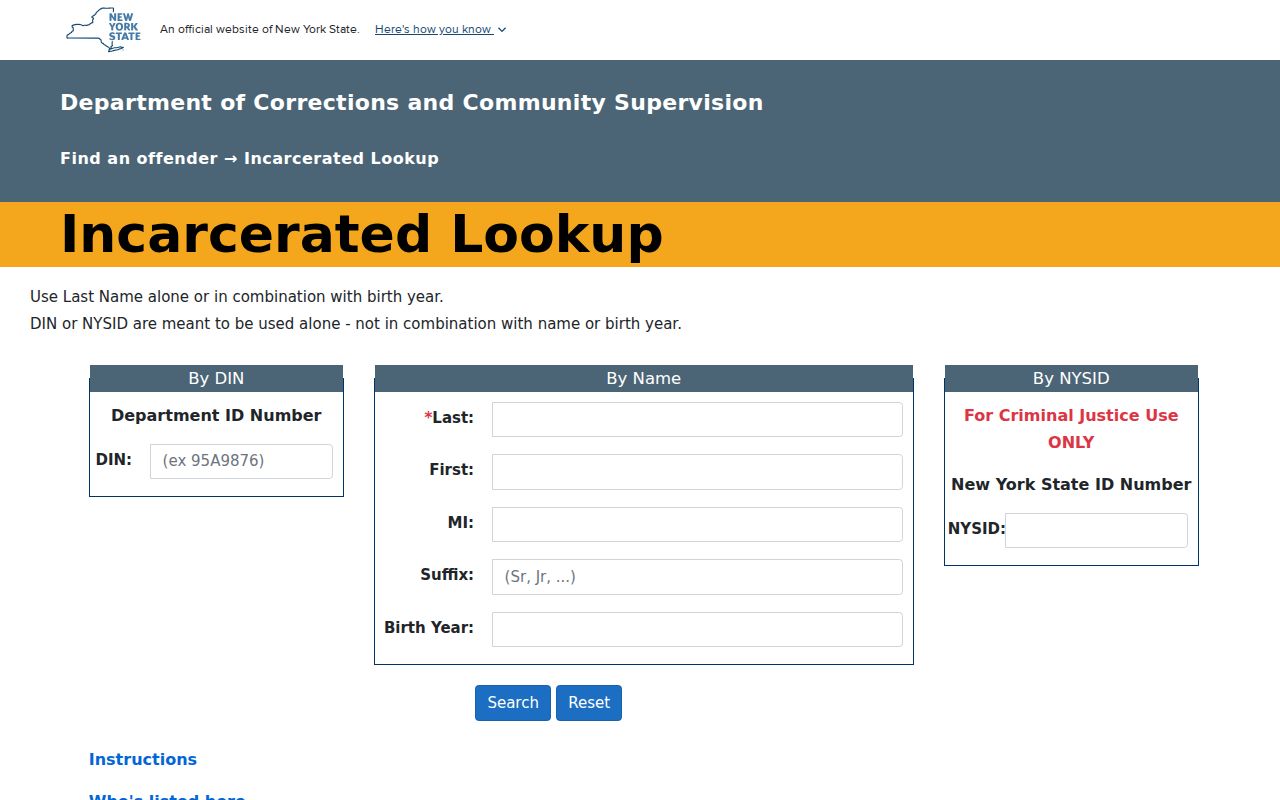
The screen marks a change in custodian: Nassau County keeps the local arrest and jail records, while DOCCS controls the later state incarceration entry.
After state release, DOCCS Parolee Lookup may show qualifying community-supervision information. Nassau County Probation is different and has no general public name-search database. Verify a probation sentence in the court file, then seek any releasable confirmation from the county department. A parole or probation status should never be inferred from an old arrest entry alone.
Arrests vs Convictions
An arrest records a law-enforcement action and allegation. A conviction records a court's guilty outcome. Nassau County police or the sheriff may show the initial charge even when the prosecutor declines it, the court dismisses it, the person is acquitted, or a plea resolves a different offense. For that reason, the court disposition should be paired with the arrest record whenever outcome matters.
| Point | Arrest Record | Conviction Record |
|---|---|---|
| Creator | Arresting agency and jail | Criminal court |
| Meaning | Custody and alleged charges | Finding or plea of guilt |
| Custodian | Police, sheriff, or Correctional Center | Originating clerk, OCA, and reported DCJS cycle |
| Possible end | Release, no prosecution, dismissal, acquittal, or later case | Sentence, appeal, or qualifying sealing |
Note: A Nassau County arrest is not proof of guilt, and the final filed charge may differ from the booking allegation.
Dismissals, acquittals, and other favorable terminations generally seal under CPL 160.50. Qualifying lesser outcomes may seal under CPL 160.55, while conviction sealing can occur under CPL 160.57 or 160.59. A public portal may then omit the event even though an unsuppressed DCJS self-review can contain restricted material authorized for the subject.
Nassau Arrest Fingerprints and DCJS Cycles
A fingerprintable Nassau County arrest generates fingerprints and a transaction control number sent to the New York State Division of Criminal Justice Services. Courts, police, and prosecutors later report charge and disposition events. DCJS links them into an arrest cycle on the person's fingerprint-matched rap sheet. A gap or “no disposition reported” notation can reflect delay or an identifier mismatch, not necessarily a still-pending prosecution.
DCJS does not offer a public name search for another person's rap sheet. The subject or the subject's attorney can request Personal Record Review through IdentoGO. The suppressed version omits sealed material; the unsuppressed version includes authorized sealed or suppressed entries. The current service codes are 15464Z for suppressed and 15465F for unsuppressed review, and the researched fee is $17.50. DCJS estimates three to four weeks and sends the response by U.S. mail.
If the rap sheet lacks a disposition or shows the wrong one, obtain the Certificate of Disposition from the Nassau County court that resolved the case and follow the DCJS challenge process. The detailed Nassau County criminal court case record is the source for filed charges and the recorded outcome.