
Criminal Cases in the Nassau County Courts
Nassau County does not place every criminal case in one courthouse. Nassau County Court handles felony indictments and trials at 262 Old Country Road in Mineola. It also has concurrent misdemeanor authority. Nassau District Court, at 99 Main Street in Hempstead, tries misdemeanors, violations, criminal traffic matters, and conducts preliminary proceedings on felony complaints. Long Beach and Glen Cove City Courts serve the two incorporated cities. Town and village justice courts handle matters within their own territory.
The court clerk keeps the accusatory instrument, docket events, motions, plea or verdict, sentence, and final disposition. Police and jail offices keep different records. A Nassau County Police Department arrest report cannot be obtained from a court clerk, and the police cannot certify the outcome of a prosecution. Start with the court shown on the appearance ticket, release papers, or WebCriminal result. If a felony was later indicted, follow it from the local arraignment court to County Court.
Felony Files at Nassau County Court
Felony case files converge at the Mineola court complex after indictment or a superior-court information. The main County Court address is 262 Old Country Road, with the West Wing at 252 Old Country Road. The main number is 516-493-3710, and the chief clerk is reached at 516-493-3690. The County Clerk serves as clerk of Supreme and County Courts, making the clerk's records counter the key route for archived files, searches, and certificates that are not supplied by an online docket.
The official Nassau County Court page provides the courthouse source shown below.
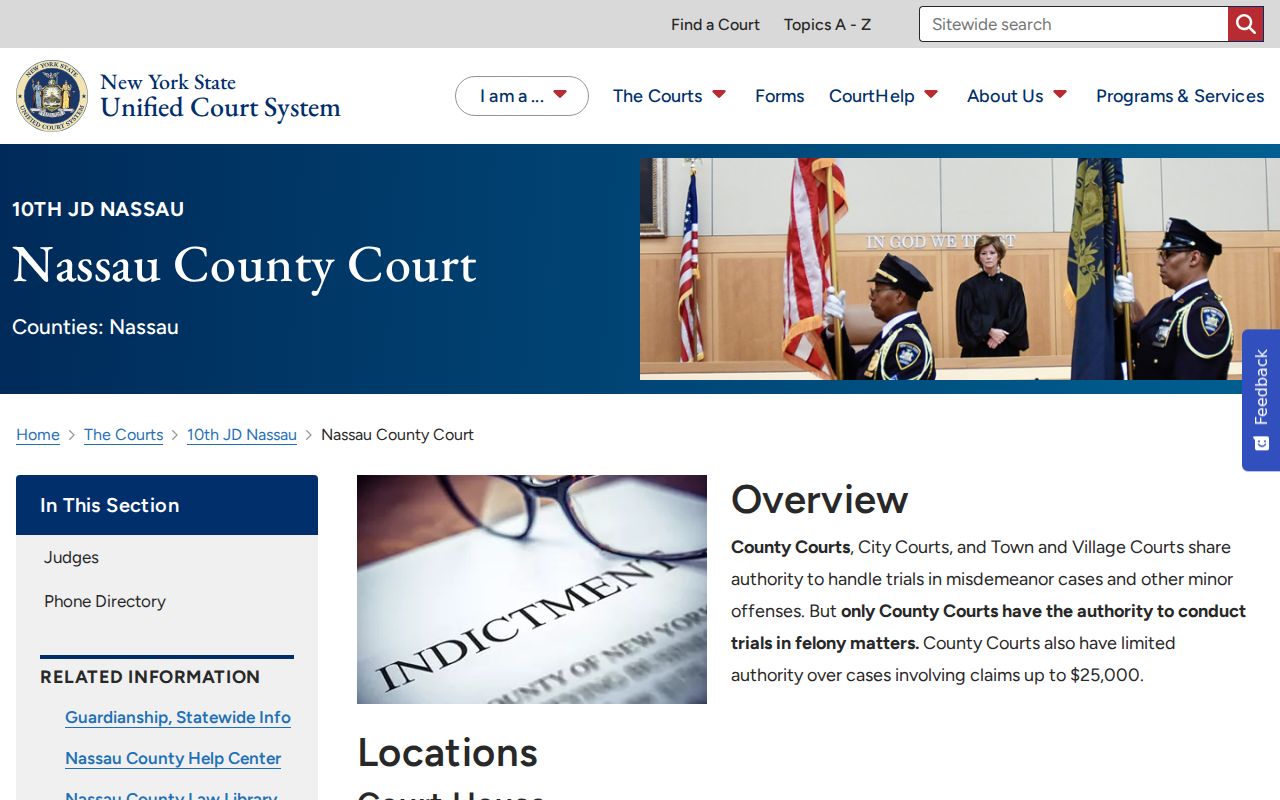
This court is the destination for the felony indictment, later motion practice, plea or trial record, and sentence, even when the first arraignment occurred elsewhere in Nassau County.
Court visitors pass security screening. The nearby Nassau Help Center and Law Library at 100 Supreme Court Drive offers internet access, forms, sample forms, handouts, Wi-Fi, and help locating information. Spoken-language and sign-language interpreter services are available through the court system. These resources can help a self-represented person identify the file or form, but staff do not replace legal counsel.
How to Search Case Records
WebCriminal is the free starting point for pending Nassau County cases and future appearances. It is an electronic court view, not a full archive. Search by defendant or case number, use Nassau as the county filter, and compare the court, part, status, and next date. A blank result can reflect a disposed case, sealing, an old local-court record, or the lack of a future appearance.
- Choose the defendant-name or case-number search mode in WebCriminal.
- Enter the known name carefully, or use the court's case identifier when available.
- Select Nassau County to narrow results and compare the listed court and status.
- Read the charge rows, appearance date, part, and event data without assuming that the arrest charge stayed unchanged.
- Contact the named clerk for older entries, document copies, or a Certificate of Disposition.
| Field or Control | Type | Required | Use |
|---|---|---|---|
| Defendant / Case Number | Tabs | Choose one | Switches the search mode |
| Last Name / Business Name | Text | Name mode | Spelling affects matches |
| First Name | Text | Not stated | Narrows defendant results |
| County | Dropdown | No | Select Nassau for local results |
| Case Number | Text | Case mode | Uses the court identifier |
| Search / Clear | Buttons | No | Submits or resets the form |
Use the case-number mode when court papers supply the identifier. It avoids the uncertainty that can come from spelling changes or people who share a name.
Searching Nassau Cases in WebCriminal
A result can display the defendant, docket or case number, court and part, case status, next appearance, appearance purpose, and charge information. Charge rows may include a statute, degree, class, count, and status. Attorney information may also appear. The interface does not promise downloadable copies of the filed papers. It also is not a live warrant-confirmation system, even when status or event data suggests a warrant.
When WebCriminal is not enough, Nassau County offers several official fallbacks. The clerk can search the court's own records. The UCS-LRS2 form requests an exact first name, last name, date of birth, court, and date range for a local search. OCA's statewide Criminal History Record Search uses exact name and birth date, costs $95 for each variation, and reports qualifying open cases and convictions. It is not certified. A court-issued Certificate of Disposition is the better record when the exact final outcome matters.
Note: A WebCriminal no-result does not prove that Nassau County has no case record for the person searched.
What the Case File Shows
The Nassau County case file records what prosecutors filed and what the court did. That identity matters because booking charges can change before an accusatory instrument, indictment, plea, or verdict. A docket should be read as a sequence. One isolated charge row does not show whether the count was amended, dismissed, merged, or resolved through a plea to another offense.
| Case Number and Court | The identifier, courthouse, part, and court level responsible for the file |
|---|---|
| Charging Document | Complaint, information, indictment, or other filed accusatory instrument |
| Docket Entries | Recorded filings, appearances, motions, orders, and event history |
| Hearing Dates | Past or scheduled appearances, courtroom or part, and purpose when transmitted |
| Disposition | Outcome for each count, such as conviction, dismissal, or acquittal |
| Sentence | Jail, prison, probation, fine, or other terms entered by the court |
Common terms need careful reading. A dismissal ends a count without a guilty finding, while an acquittal follows a not-guilty determination. A plea is a conviction. An adjournment in contemplation of dismissal remains pending until its conditions mature and the matter is dismissed. If the docket and another record disagree, use the Certificate of Disposition from the originating court to establish the recorded outcome.
Nassau Court Fees and Certified Outcomes
A local court-record search and a certified outcome are not the same product. The UCS-LRS2 local search costs $5 for each two-year period or fraction, for each exact name and date-of-birth variation. The form asks for the selected court, requester contact details, subject name and birth date, and the date span. A Certificate of Disposition ordinarily costs $5 outside New York City and supplies the official court outcome.
The Nassau County legal-fees page is the source for the County Clerk fee display shown here.
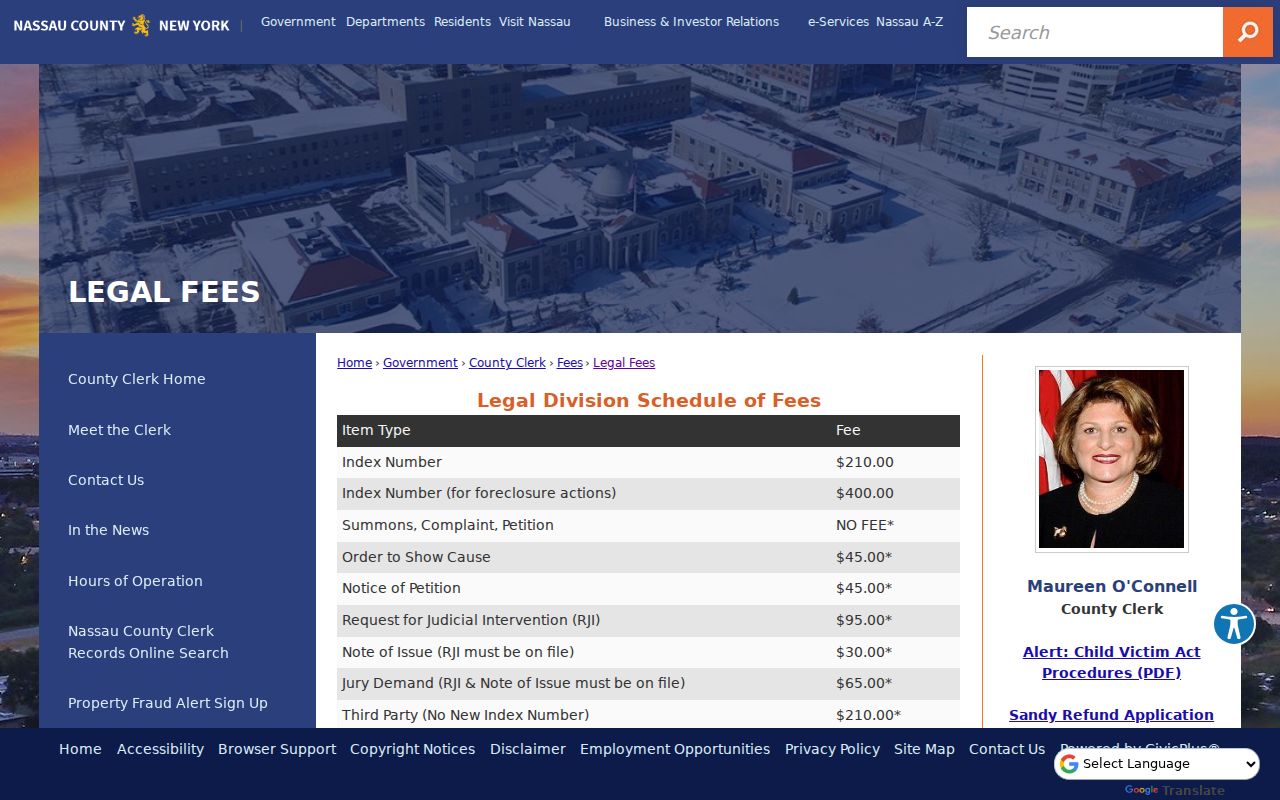
The fee schedule reinforces why a requester should name the exact document needed. A broad search, an ordinary copy, a certified copy, and a disposition certificate serve different purposes and can carry different charges.
Use the local clerk when the court is known. Use OCA CHRS when a statewide exact-match summary fits the question. A person reviewing their own complete fingerprint-linked New York history should instead use DCJS Personal Record Review through IdentoGO. DCJS does not provide another person's rap sheet, and neither CHRS nor a local name search replaces a certified case document.
Stages of a Criminal Case
A Nassau County matter may start with an arrest or appearance ticket and an arraignment in District Court, a city court, or a town or village justice court. A misdemeanor can stay in that local criminal court. A felony complaint begins there for arraignment and preliminary steps, but an indictment or superior-court information sends the prosecution to County Court. Motion and discovery conferences follow, then a plea or trial, disposition, sentence, and any appeal.
Case flow: Charges Filed › Arraignment › Pretrial › Plea or Trial › Disposition › Sentencing
The Nassau County District Attorney's official page supplies the office image below.
The District Attorney prosecutes cases and may file or change charges, but the court remains custodian of the docket and final disposition. The Nassau County Legal Aid Society provides assigned defense in qualifying matters, while confidential lawyer files are not public court records.
Reading Nassau Court Charge Classifications
New York docket entries often compress offense class into short labels. County Court handles the felony track. General maximum terms range from up to four years for a Class E felony through up to 25 years for a Class B felony, while Class A felonies can carry life maximums. Those are broad statutory frames, not predictions. Violent, drug, sex, repeat-offender, and offense-specific rules can change the range.
Local criminal courts handle Class A misdemeanors, which generally carry up to 364 days, Class B misdemeanors, which generally carry up to three months, and violations, generally up to 15 days unless another law sets a fine-only rule. The offense statute, Penal Law sentencing rules, and the final disposition must be read together. An “E Felony” arrest entry may later resolve as a misdemeanor or dismissal. For the clearest result, match each charge to its disposition row and sentence rather than treating the highest original level as the outcome.
Access & Restrictions
Open court access does not make every Nassau County case visible online. Sealed matters are withheld. Youthful-offender adjudications are confidential, and Family Court juvenile matters are not ordinary public criminal convictions. Victim details, protected identities, and sensitive information may be redacted. WebCriminal also has practical limits because it focuses on pending cases and future appearances rather than serving as a full historic archive.
Judicial records follow Unified Court System access rules rather than the same FOIL route used for an executive agency such as NCPD. Ask the originating clerk about a missing file or redacted online view. If a court outcome has not reached DCJS, obtain the disposition and use the DCJS challenge process. Broader context on the arrest that began a prosecution appears in the Nassau County arrest history record held by police or the jail.
When Nassau Court Results Vanish
A missing result has several possible causes. The case may be disposed, sealed, too old for the electronic view, recorded under an exact-name variation, held by a town or village court, or absent because no future appearance remains. OCA CHRS also omits sealed matters, noncriminal infractions, pardoned dispositions, Family Court transfers, and other specified results. Its town and village disposition coverage is incomplete from May 1991 through 2007, with comprehensive reporting beginning in May 2007.
Work backward from known facts. Confirm the arrest location and court named on the papers. Ask that clerk to search its own index. Order a Certificate of Disposition if the outcome is needed. If the search must span New York courts, consider OCA CHRS with the exact name and birth date. For errors on one's own fingerprint record, obtain the court document first and then challenge the DCJS entry. This sequence separates a genuine access restriction from a search mismatch or reporting delay.
Note: Sealing restricts access to a Nassau County case; it does not necessarily mean every underlying record was physically destroyed.